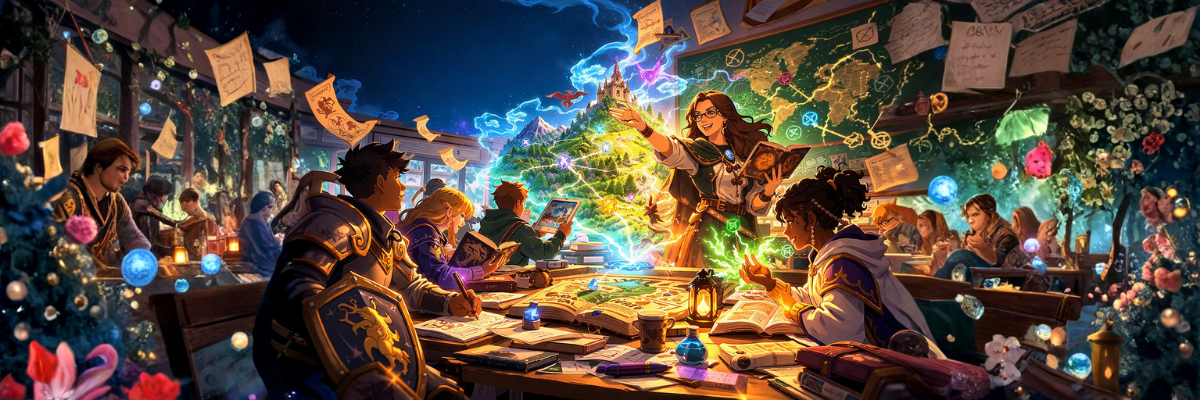
Role Playing Games as Engagement and Motivation in Classrooms
How to Turn Your Classroom Into a Role Playing Campaign
A Step-by-Step Guide for Teachers
Keeping students engaged can feel like a constant battle. Many teachers experiment with reward systems, participation points, or classroom competitions, only to find that the excitement fades after a few weeks.
A growing number of educators are discovering a different approach: turning their classroom into a role-playing game (RPG).
In an RPG classroom, students become heroes on a quest for knowledge. Lessons become missions. Units become story arcs. Assessments become epic boss battles.
This approach blends storytelling, teamwork, and game mechanics into a learning experience that students genuinely look forward to.
In this guide, we'll walk through how teachers can build a classroom RPG system step by step.
What Is a Classroom RPG?
A classroom RPG is a learning system that applies elements from role-playing games to classroom activities.
Instead of simply completing assignments, students participate in an unfolding adventure where their academic progress drives the story forward.
Typical RPG classroom elements include:
-
Hero roles or classes that students choose at the beginning of the term
-
Quests that represent lessons or assignments
-
Experience points or rewards for completing work
-
Team collaboration between different roles
-
Boss battles that act as review activities or assessments
Students feel like they are progressing through a narrative rather than simply completing tasks.
For many teachers, this transforms classroom motivation almost overnight.
Why RPG Classrooms Work
Role-playing systems tap into several powerful motivational principles.
Progression
Students love visible progress. When learners gain experience, levels, or rewards, they feel a sense of accomplishment that traditional grading systems often fail to provide.
Narrative
Humans naturally connect to stories. When lessons are framed within a narrative, students become curious about what happens next.
Collaboration
Many RPG classrooms place students into teams where different roles support one another.
Challenge
Boss battles, puzzles, and quests create meaningful challenges that encourage problem solving and critical thinking.
Together, these elements can dramatically increase classroom engagement.
Core Mechanics of a Classroom RPG
You do not need complicated systems to start using RPG elements in your classroom. Many teachers begin with just a few simple mechanics.
1. Hero Roles
Students choose a role or class at the start of the course.
For example:
-
Guardians – protectors who help their team survive challenges
-
Mages – damage dealers who bring down enemies
-
Healers – supporters who assist teammates and recover lost health points
These roles can have simple classroom abilities or bonuses.
Students enjoy identifying with a role and contributing to their team's success.
2. Quests
Assignments and lessons become quests.
Examples:
-
Investigate a mysterious ecosystem
-
Decode the structure of DNA
-
Analyze the rise and fall of ancient civilizations
Each quest moves the story forward and unlocks the next stage of the adventure.
3. Rewards and Progression
Students earn rewards such as:
-
experience points
-
gold
-
special abilities
-
classroom privileges
These rewards recognize effort and persistence rather than just final scores.
4. Boss Battles
One of the most exciting elements of RPG classrooms is the boss battle.
Boss battles typically occur at the end of a unit and function as review sessions or assessments.
For example:
Students might face a mythical creature representing the concepts from the unit.
To defeat the boss, teams must answer questions, solve problems, or complete challenges related to the content.
This turns review activities into memorable classroom events.
Example: A Biology RPG Unit
Imagine a high school biology class studying ecosystems.
The story might begin with a mysterious forest where balance has been disrupted.
Quest 1
Students investigate food webs and identify predator–prey relationships.
Quest 2
Students analyze energy flow through ecosystems.
Quest 3
Students explore how disturbances affect biodiversity.
Boss Battle
Students confront the Dustkeeper of the Withered Forest, a creature representing ecological collapse.
To defeat the Dustkeeper, teams must answer review questions about energy pyramids, trophic levels, and ecosystem balance.
By the end of the unit, students have reviewed the content while participating in a collaborative adventure.
The Challenge of Running an RPG Classroom
Designing a classroom RPG can be incredibly rewarding, but it can also take time to manage.
Teachers who attempt this system manually often find themselves juggling:
-
spreadsheets to track rewards
-
hand-written quests
-
classroom scoreboards
-
team progress tracking
-
story development
While many teachers successfully run small RPG systems with paper and whiteboards, managing a full classroom game can quickly become complex.
Tools That Support RPG Classrooms
Because of this challenge, some teachers choose to use platforms designed to support gamified learning environments.
These platforms help manage features such as:
-
student roles
-
rewards and progression systems
-
quests and assignments
-
collaborative challenges
-
boss battle events
One example is Academy of Heroes, a classroom platform where students become heroes progressing through a fantasy world tied to real academic content.
Teachers can design quests aligned with their curriculum while students earn rewards, collaborate with teammates, and face boss battles at the end of major story arcs.
Instead of managing spreadsheets and scoreboards manually, the system tracks progress automatically.
Tips for Starting Your First Classroom RPG
If you are interested in trying this approach, start small.
-
Begin with a simple story theme for your unit.
-
Turn assignments into quests with clear objectives.
-
Create teams or roles to encourage collaboration.
-
Use a boss battle review activity at the end of the unit.
Even a lightweight system can dramatically change classroom energy.
Once students begin to see their progress as part of an adventure, participation and motivation often increase.
Final Thoughts
Turning your classroom into an RPG may sound unusual at first, but many teachers find that it creates a learning environment where students feel invested in their progress.
When lessons become quests and reviews become boss battles, learning begins to feel less like routine work and more like an unfolding journey.
For teachers interested in exploring this style of gamified learning, systems like Academy of Heroes provide a structured way to run a classroom RPG without building every component from scratch.
Ready to bring the adventure to your classroom?
Academy of Heroes turns your class into an RPG — students level up, earn abilities, and go on quests. Free to try, no credit card required.
Start Your Free Trial →