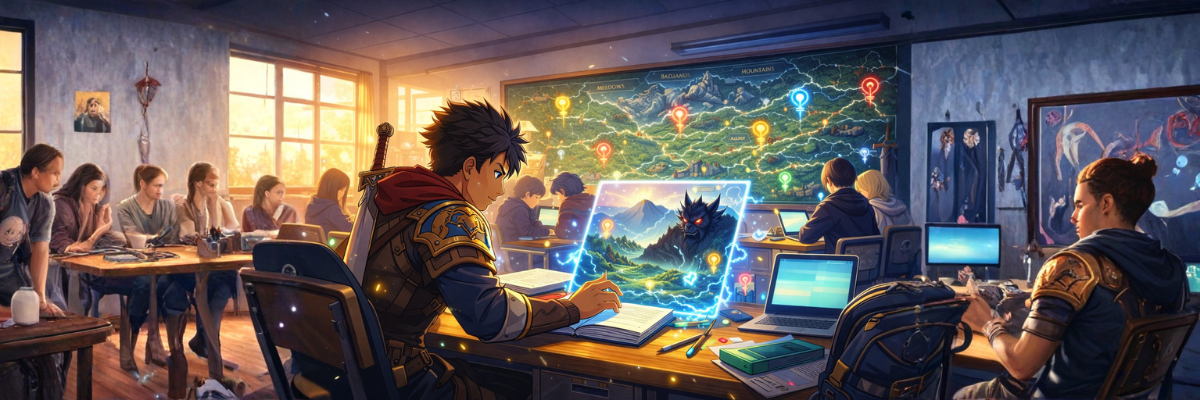
The Power of the Solo Patrol: How Student Self Practice Can Transform Classroom Motivation
There's a moment every teacher knows. The quiet pocket of time after a lesson wraps up early, during independent work, or when a few students are simply finished before everyone else. What do you do with it? For most classrooms, that moment disappears into phones, restlessness, or the low hum of students pretending to look busy.
What if that pocket of time was the moment a student decided to level up their hero?
Mastery Practice Doesn't Have to Feel Like Practice
One of the most persistent challenges in education is getting students to willingly review content. Flashcards feel like chores. Re-reading notes puts even motivated learners to sleep. Practice worksheets are, at best, tolerated.
But what if reviewing the material meant venturing into a dangerous wilderness, facing a monster drawn from the world your class has been building all semester — and walking away with gold and experience points that make your character measurably stronger?
That's the premise behind Solo Patrols — one of the most quietly powerful engagement tools available to gamified classrooms. And unlike class-wide events that require everyone to participate at once, patrols happen on the student's own schedule, at their own pace, entirely under their own agency.
How Solo Patrols Work
When a student launches a solo patrol, they choose a destination. Three regions await: the Meadows, the Badlands, and the Mountains. Each represents a different tier of challenge. The Meadows offer a calm entry point — perfect for newer heroes or students just getting their footing with the material. The Badlands push harder. The Mountains are for those who are ready to truly test themselves.
Each region is home to monsters built from teacher-created question banks. The student enters combat and faces questions drawn from the active sections their teacher has set up. These aren't multiple choice — they're open-ended challenges graded by AI, which evaluates the student's response against an ideal answer and keyword rubric, then delivers instant feedback on what they got right, what they missed, and how to think about it differently.
Answer well, and the student deals damage to the monster. Struggle, and the monster strikes back — sometimes with powers of its own. The battle plays out round by round, with the student's hero health on the line. Defeat the monster — victory, rewards, and a detailed summary await. Take too much damage and fall — the hero needs to recover before patrolling again.
Every outcome teaches something. The patrol summary screen shows the full battle log: every question, every answer, every piece of AI feedback, and a downloadable PDF the student can keep as a study guide.
The Arsenal: Powers and Items Change Everything
Here's where solo patrols become genuinely strategic — and where the motivation to level up your character becomes something a student feels in their bones.
Every hero belongs to one of three classes: Guardian, Healer, or Mage. As students level up their character through quests, good behavior, and classroom participation, they unlock class-specific patrol powers — active abilities they can deploy mid-combat using MP (mana points). These aren't passive bonuses. They're decisions.
A Guardian might channel Rallying Cry before answering the next question — boosting their attack damage if they nail it — or throw up Unyielding as a temporary shield to absorb the monster's next hit. A Healer can cast Mend to recover HP when they're running low, or call on Righteous Fury when they know they're about to give a strong answer. A Mage hurls Fire Bolt for direct damage, wraps themselves in Ice Armor for defense, or taps Arcane Siphon to recover health at a critical moment.
Each power comes in four tiers. Tier 1 is available early. Tier 4 is powerful — but expensive in MP and only accessible to heroes who have put in the work to unlock it. A student running Tier 4 abilities in the Mountains is a student who has spent an entire semester building toward that moment.
And then there are items.
Students earn gold from patrols, quests, and classroom performance — and that gold can be spent on consumable items held in their inventory. Healing potions that restore HP mid-fight. Damage-boosting elixirs that supercharge the next attack. Defense tonics that reduce incoming damage. MP restorers that refill the tank when a student has burned through their abilities. These items are finite, earned through play, and the decision of when to use them is entirely the student's.
A student deep in the Mountains, HP low, facing a powerful monster with one healing potion left — that's not just a game moment. That's resource management, risk assessment, and consequential decision-making dressed up as an adventure.
The Engine Behind It: Student-Driven Motivation
Here's what makes patrols different from any other review activity: the student wants to do them.
Not because a teacher told them to. Not because it's for a grade. But because completing a patrol makes their hero stronger — and a stronger hero, with better powers and a stocked inventory, survives encounters that would have ended them a month ago.
This is the loop that self-motivated learning is built on. Students who care about their character's level, their gold count, and their standing in the class ecosystem will seek out patrols the way a gamer seeks out side quests. They'll use the five minutes before class starts. They'll ask if they can patrol during free reading time. They'll come back the next day with a strategy for the monster that defeated them — and with the Tier 2 power they just unlocked ready to go.
The patrol system doesn't just reward knowledge — it rewards persistence. A student who fails a patrol, reads their feedback, and comes back to try again is practicing exactly the kind of metacognitive resilience that educators spend careers trying to cultivate. And a student who grinds patrols to afford better items and unlock higher-tier powers is demonstrating sustained, self-directed effort in a way that no worksheet ever inspired.
What Teachers Control
The solo patrol system is entirely shaped by the teacher, with a level of customization that makes it adaptable to any classroom, any subject, and any instructional goal. The monsters are pre-loaded by Academy of Heroes, with stronger stats and powers based upon Patrol Location....but YOU decide which questions go where. You can put harder question into Badlands or Mountains.....or.....put all of the same questions in every location, and just count on the stronger monsters that live there to provide a sufficient challenge.
Question Banks — Teachers build out patrol sections organized by topic, unit, or standard. Each section is tagged to a difficulty tier and can be toggled active or inactive at any time. Running a new unit? Activate those questions. Finished a chapter? Retire that section and bring in the next. Students always encounter questions that reflect where the class currently is.
Daily Patrol Limits — To keep patrols from becoming an all-consuming distraction, teachers can set a daily cap on how many patrols a student can run. The student's dashboard shows exactly how many patrols they have left for the day, creating natural pacing that keeps engagement sustainable.
XP and Gold Awards — Each difficulty tier has its own configurable reward pool. Meadows offer a modest payout. Badlands yield more. Mountains deliver the biggest haul. Teachers calibrate how much experience and gold each victory is worth, keeping patrol rewards meaningful within the broader classroom economy.
Performance Bonuses — Score-based bonus tiers can be enabled, so students who answer exceptionally well earn additional XP and gold on top of the base reward — a mechanical incentive for not just completing a patrol, but doing it well.
AI Grading Sensitivity — Because patrol questions are open-ended, the AI grading engine offers four sensitivity levels: Lenient, Standard, Strict, and Expert. Teachers can match the grading bar to their classroom's current skill level and raise it as the year progresses.
The Quiet Revolution of Optional Practice
There's something remarkable that happens in classrooms where solo patrols are running well. Students stop thinking of review as a teacher-imposed obligation. It becomes something they own.
The student who finishes a quiz early and immediately opens the patrol screen. The student who mentions over lunch that they finally beat the mountain monster after saving up for a Tier 3 damage power. The student who asks the teacher what questions are in the new section because they want to prepare their inventory before attempting it.
When going on Patrol, students find a system that made the work feel like their decision — and gave them real tools to succeed or fail on their own terms.
Solo patrols give students the power to grow at their own pace, with abilities earned through effort and items bought with gold they worked for. In a world where student motivation is one of the hardest things to manufacture, it turns out the secret might be simpler than anyone expected: give them a monster worth fighting, give them the tools to face it — and then get out of the way.
Want to bring solo patrols to your classroom? Academy of Heroes gives teachers the tools to build custom patrol systems, set daily limits, manage question banks by difficulty, and watch students chase mastery on their own terms.
Ready to bring the adventure to your classroom?
Academy of Heroes turns your class into an RPG — students level up, earn abilities, and go on quests. Free to try, no credit card required.
Start Your Free Trial →